Showing posts with label Food. Show all posts

Monday, May 19

DANSKE RAPSOLIE


Sometimes referred to as Field Mustard, I had always thought the fields of yellow I saw in Canada were exactly that, mustard.  In fact, it's Canola.  Perhaps you knew this already and I'm a bit slow to identify this popular cash crop...  When touring around Skælskør, or on your way to one of the surrounding towns of Borreby, Næstved, or Slagelse, the Danish rural landscape at this time of year is a stunning blanket of yellow.  


Canola oil is produced from the crushing of the rapeseed.  The word "rape" in rapeseed comes from the Latin word rapum meaning turnip. Turnips, rutabaga, cabbage, brussel sprouts, and mustard are all related to the two natural canola varieties commonly grown, which are Brassica napus and Brassica rapa.  The Danes use this literal translation Rapsolie (rapeseed oil).  Since canola was bred naturally from rapeseed at the University of Manitoba by Keith  Downey and Baldur R. Stefansson in the early 1970s, and most likely disproving of the alternate meaning of the word "rape", the plant and oil product was retitled canola (the "can" standing for Canada and "ola" oil).  Some dictionary sources state that Canola stands for "Can(ada)+o(il)+l(ow)+a(cid)" as this plant was engineered to have a different nutritional profile and much less erucic acid. 


Brassica oilseed has a long history of being cultivated dating back 4,000 years in India, 2,000 years in China and Japan and in 13th century Northern Europe.  Primarily produced in small quantities as fuel for oil lamps, its use was limited until the development of steam power and the discovery of its use as a lubricant.  During WWII when this product became in high demand, Canada began to expand its limited rapeseed production as the war blocked European and Asian sources of rapeseed oil.

After the war, however, the demand sharply declined and Canada began to look for other uses for rapeseed.  In 1956-57 rapeseed oil extracts were first put on the market as as food products.  This was not successful due to the disagreeable greenish colour, a high concentration of erucic acid and a distinctive taste.  Hence the breeding of canola from rapeseed in the early 70s.


Originally a trademark, canola is now a generic term for edible varieties of rapeseed oil in North America and Australia.  Once considered a specialty crop in Canada it's now a major American cash crop.  Canada and the US produce between 7 - 10 million tonnes of canola seed per year.  Annual Canadian exports total 3 - 4 million tonnes of seed, 800 000 tonnes of canola oil and 1 million tonnes of canola meal.  Canada rates 2nd for top rapeseed producers in the world, after the European Union in 1st.  Denmark rates 16th in the world only 4 countries after the US at 11th place.  That is a lot of rapeseed production in Denmark considering how small this country is.   Who knew canola could be both so beautiful and mildly interesting.


Monday, April 14

MATZO BREAD


I have to be honest, this matzo (matzah) was purchased because I liked the packaging and have a penchant for bland crackers.  With an inkling that the thin, perforated bread is part of the Passover holiday (April 14 - 22 this year), I decided to learn more.

Passover commemorates the liberation of the Israelites from their Egyptian enslavers as outlined in Exodus.  Matzo is special because it is unleavened and it is eaten at this time to symbolize the sudden departure from Egypt (the bread had no time to rise).  Matzo is a simple bread, also eaten as a symbol of humility and a reminder of the days of servitude; unlike risen bread (chametz), it is flat and not puffed up, the symbolic antithesis of a proud person. 

You are not to eat any chametz with it; for seven days you are to eat with it matzah, the bread of affliction; for you came out of the land of Egypt in haste.  Thus you will remember the day you left the land of Egypt as long as you live. - Deuteronomy 16:3


In preparation for Passover, observant Jewish people will rid their houses completely of chametz. Chametz includes not just risen bread but cereal, beer, pizza, cookies, etc. Even little crumbs are not tolerated; the entire home, from cupboard to couch cushion is fully cleaned.  If the household wishes to retain the chametz for after Passover they can sell it to someone who isn't Jewish through a Rabbi, to be re-purchased after Passover. The chametz can stay in your house but must be isolated from other food and be inaccessible to the household. 


To me this preparation for Passover appears as tradition firmly rooted in common sense.  Akin to "spring cleaning," ridding the house of those leftover bits mouldering at the back of the cupboard is good housekeeping.  Also, the symbolic "puffed up" nature of chametz can create a very real expansion of the waistline and purging such products from the shelves could promote better health.  So many bread products are comfort food, craved in the cold winter months.  A week away from these addictive victuals could turn the tide towards summer salads.  This coming from the land of the baguette.

Passover information was found here

Monday, March 31

LADURÉE


This past weekend I visited Heather in Paris on my way to Skælskor, Denmark.  I had Saturday morning to myself where I walked the galleries at Musée d'Orsay and Musée  de l'Orangerie, and before meeting Heather at the Grand Palais for Art Paris (to be featured on Thursday), I stopped in at Ladurée House to purchase a box of their beautiful macarons.  Available in a wonderful selection of colours, I chose 6 flavours from a legend describing them in French, English and Japanese.  I can see why these would be popular with Japanese tourists, and I too love the novetly of them (you also choose a box in black, pink, mint green or pale blue).

Founded in 1862, a luxury bakery and sweets maker, Ladurée is internationally renowned for their stacked macaron.  In the middle of the 20th century, Pierre Desfontaines first though of taking two macaron shells and joining them together with a ganache filling.  Ladurée sells approximately 15,000 everyday!


Monday, November 18

TORVEHALLERNE KBH


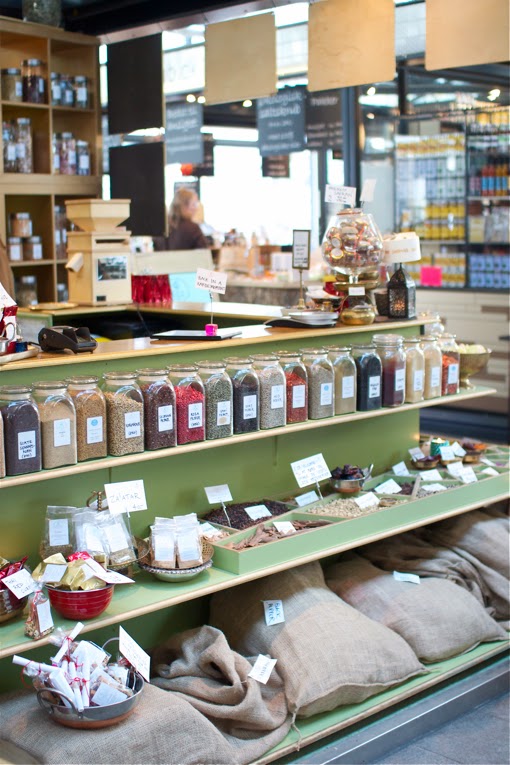
Allow me to play culinary cupid for a moment and imagine the love child of Toronto's St. Lawrence Market and the famous food halls of Harrods. The offspring of these two taste titans would surely be a site to behold, let alone devour. It's literally a feast for the senses. 

Upon entry the nose is immediately filled with the smell of exotic spices from far away lands. The ears detect the noisy chatter of patrons happily eating up fresh made pasta, steak sandwiches, and a wonderful offering of bite sized pieces of fresh baguette laced with house made prosciutto and the most tender of pickled asparagus. The eyes can gaze upon the offerings from multiple fish mongers, their local fresh and smoked specimens playfully displayed. The hands may want to inspect the local produce to find just the right potato to go with tonight's dinner. Taste....anything...actually taste everything. 

I'm serious, there's nothing out of place here. Just individual stalls with friendly, knowledgeable vendors. Taste tacticians, specializing in almost everything one could need : oils, nuts, cheese, meat, fish, wine, spices, coffee, chocolate, bread, sweets...did I mention everything is the best quality I've ever tasted?  

You probably think I'm teasing you with this impossibly savoury seductress but I tell you it's here in Copenhagen. 

It's called Torvehallerne Kbh, and take it from a guy who likes eating and takes it very, very seriously....this place might be the reason I move here, for good. 

Guest contributor Afie Jurvanen