The Common Mullein, or verbascum thapsus, was introduced to my front yard by a friend who referred to it as the "Grand Wizard of the Ontario Roadside". His attempts at cultivation were unsuccessful, however, many years later this spectacular example of the species sprouted.
Turns out the tiny seeds can remain in the soil for up to a hundred years, often sprouting after a forest fire or a clearing of other vegetation. The plant is biennial, producing a rosette of soft and hairy leaves the first year, followed by the tall stalk of yellow flowers the subsequent summer. The plant usually dies after this display, scattering almost a quarter million seeds.
Mullein has been used for medicinal reasons for over 2000 years. It is most effective against afflictions of the lungs such as consumption, croup and coughs. The yellow flowers can be used to create a yellow or green dye and the stalk can be soaked in wax to create a torch.
Imported to North America in the early 1800's, Mullein quickly spread to all states and southern Canada. In some regions it carries the vernacular name "Cowboy's toilet paper". Driving north, you can see Common Mullein along the road and the further you drive, the shorter the stalks. None of these northern brothers can rival the 9' monster dominating my yard, impressive enough to entice a woodpecker:
I've always wanted to dye with natural indigo. There is something magic about the way the rich blue colour is created by the oxygenation of the dye. What starts as yellow/green in the dye bath quickly turns blue when touched by air. So, when a friend requested the use of my yard for his indigo kit, I said "Yes!" Turns out indigo is a great party activity - the excitement of the colour change somehow summoned Dionysus and corks started flying. Sedate folding patterns gave way to tie dye and experimentation. Although the results were not as successful as the event, the experience left me wanting to try again and perhaps gather up some walnut husks for another event .... Perhaps Hades will show up.
If you're interested in indigo dyeing, check out a very detailed description of the processhere (I haven't tested their steps), and ways to tie and fold your fabric here.
Sometimes referred to as Field Mustard, I had always thought the
fields of yellow I saw in Canada were exactly that, mustard. In fact,
it's Canola. Perhaps you knew this already and I'm a bit slow to identify
this popular cash crop... When touring around Skælskør, or on your way to
one of the surrounding towns of Borreby, Næstved, or Slagelse, the Danish rural
landscape at this time of year is a stunning blanket of yellow.
Canola oil is produced from the crushing of the rapeseed. The
word "rape" in rapeseed comes from the Latin word rapum
meaning turnip. Turnips, rutabaga, cabbage, brussel sprouts, and mustard
are all related to the two natural canola varieties commonly grown, which are Brassica
napus and Brassica rapa. The Danes use this literal
translation Rapsolie (rapeseed oil). Since canola was bred
naturally from rapeseed at the University of Manitoba by Keith Downey and
Baldur R. Stefansson in the early 1970s, and most likely disproving of the
alternate meaning of the word "rape", the plant and oil product was
retitled canola (the "can" standing for Canada and "ola"
oil). Some dictionary sources state that Canola stands for
"Can(ada)+o(il)+l(ow)+a(cid)" as this plant was engineered to have a
different nutritional profile and much less erucic acid.
Brassica oilseed has a long history of being cultivated dating back 4,000 years in India, 2,000 years in China and Japan and in 13th century Northern Europe. Primarily produced in small quantities as fuel for oil lamps, its use was limited until the development of steam power and the discovery of its use as a lubricant. During WWII when this product became in high demand, Canada began to expand its limited rapeseed production as the war blocked European and Asian sources of rapeseed oil.
After the war, however, the demand sharply declined and Canada began to look for other uses for rapeseed. In 1956-57 rapeseed oil extracts were first put on the market as as food products. This was not successful due to the disagreeable greenish colour, a high concentration of erucic acid and a distinctive taste. Hence the breeding of canola from rapeseed in the early 70s.
Originally a trademark, canola is now a generic term for edible
varieties of rapeseed oil in North America and Australia. Once considered
a specialty crop in Canada it's now a major American cash crop. Canada
and the US produce between 7 - 10 million tonnes of canola seed per year. Annual Canadian exports total 3 - 4 million tonnes of seed, 800 000
tonnes of canola oil and 1 million tonnes of canola meal. Canada rates
2nd for top rapeseed producers in the world, after the European Union in 1st.
Denmark rates 16th in the world only 4 countries after the US at 11th
place. That is a lot of rapeseed production in Denmark considering how
small this country is. Who knew canola could be both so beautiful and mildly interesting.
Wisteria always makes me think of murder. It was probably the Sherlock Holmes story "The Adventure at Wisteria Lodge" that got me started, but having lived with Wisteria for many years, I've come to learn her strangling ways as she has attempted to choke the lilac and the power cables. I do believe that Wisteria could eventually pull the house down if left to her own devices.
I'm lucky to get a score of blooms, so I was shocked and jealous to see the purple petals in abundance all over Paris. That town loves to prune so rethinking my tentative snips, I got aggressive in preparation for Toronto's spring. You'll see her at the bottom looking naked and forlorn in contrast to her French sisters.
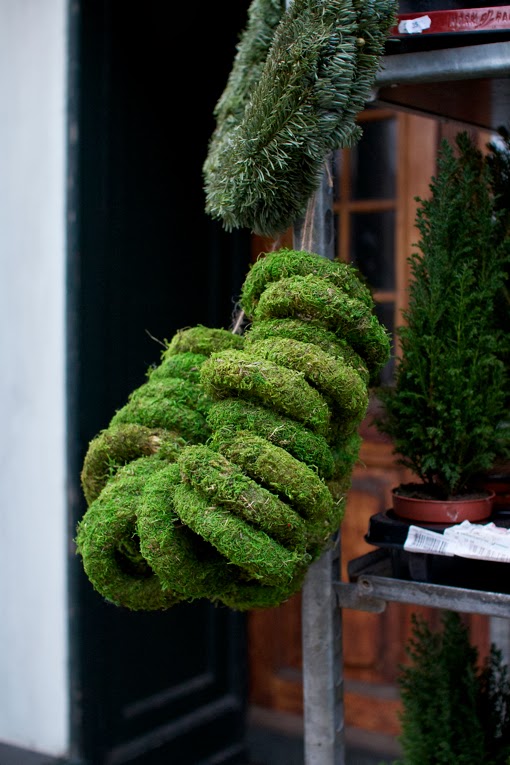
I hate taking the tree down. The cold months ahead could perhaps benefit from "winter foliage"to tide us over till the tulips of spring. Here are some inspiring arrangements from the streets of Copenhagen.