Wednesday, January 22

KATIE BETHUNE-LEAMEN


We visited Katie Bethune-Leamen's apartment just as the cold was setting in on Toronto. With many distractions from her cat Quincy we watched the sun set over the Landsdowne No Frills and talked about residencies, the North and Hologram TuPac.

Bethune-Lehman's work is immediately engaging because of it's deceptively simple and sometimes-comic nature.  This straightforwardness belies inner layers that seek back to the myths and mysterious at humanity's core.  She seems to have a fascination with the cold places and the things that fall into them from beyond our stratosphere.  Ghosts, mummers, icebergs, hats, meteors and explorers people her work.  Whether wearable sculpture, video, performance or object, she has a way of presenting work that seems to reveal the making, yet trick the viewer as to what they are actually experiencing.

The "hologram" of Tupac (that was not a hologram but a Victorian parlour trick) that showed up at Coachella in 2012 holds an enduring interest for Bethune-Leamen.  Blue masks of many shapes and media referencing this event are throughout her apartment, propositions of things to come. 

In recent years Bethune-Leamen has participated in many residencies including: Fogo Island Arts Residency, off the coast of Newfoundland; SIM Residency in Reykjavik, Iceland and in 2014 she will be the artist in resident at LKV in Trodheim, Norway.  She describes residencies as a way to "trouble the practice". Taken away from familiar materials and routines, she has a knack for creating ritualized and powerful work using what is at hand: both mundane materials, the beauty and magnitude of the surrounding land and people she meets along the way.


Tuesday, January 21

MANUFACTURE DES GOBELINS


Gobelins Tapestry Factory has been running intermittently since the 17th century. Now a state run institution since 1937, they specialize in 4 techniques: High warp looms (Gobelins tapestry) low warp looms (Beauvais tapestry), pile (Savonnerie carpets) and tapestry restoration.  I took a tour this week and was able to see weavers (licier) in action (unfortunately photography was not allowed inside).  The guide whisked us quickly through the courtyard which served as a town square in earlier days; Paris was yet to surround the factory and the workers made up their own community.  You can see above the chapel they used, steps away from where Louix XIV would inspect tapestries hung outside from hooks still intact today (but covered by scaffolding on my visit).

The high warp looms are in the yellow building dating from 1660 (pictured below), but the remaining facilities are across what used to be the Bievre river (now a road) in a 1960's lowrise.  Romance aside, the new buildings have better light.  In order to work here you must train for 4 years in weaving techniques as well as colour, design theory and art history.  All work is made for use by the state or as diplomatic gifts.  The designs are chosen by the directors from original artwork or reproductions of existing tapestries.  In most cases the technicians work from the actual artwork rather than using a photograph or copy so as to capture the exact tones and textures of the piece.  Each tapestry takes years of labour and I couldn't help but wonder if the weavers ever despaired over a design they despised.


In the 17th century, Charles Le Brun (chief painter for Louis XIV), was the director at Gobelins.  The tapestries which he designed and managed, many made for Versailles, were executed with very fine thread so that each worker would only complete approximately 1 meter square per year.  Today, much thicker yarn is used unless a reproduction is being made.

The gallery accompanying the production facilities is currently presenting an exhibition of tapestries from their collection highlighting nature in design.  Below you will see a chronological sampling from the 15th through to the 21st century where you'll be able to see changes in both complexity and style.


Verdure (detail), Aubusson Tapestry, 1671


Vedure a Portique (detail), Tapestry from Audenarde, 1560-1580

Verdure (detail), Tapestry from Flanders, 16th century

Le Printemps (detail), by Charles le Brun, Gobelins Tapestry, 1709

Le Printemps (detail), by Charles le Brun, Gobelins Tapestry, 1709


Le Printemps (detail) by Jean Lurcat, Tapestry of Aubusson, 1946


Le Printemps (reverse) by Jean Lurcat, Tapestry of Aubusson, 1946

L'embellie by Paul-Armand Gette, Gobelins Tapestry, 2008


Fruits Fleurs Poissons by Yves Oppenheim, Gobelins Tapestry, 2010


Sunday, January 19

DIGOIN & SARREGUEMINES


While in Paris, I've been determined not to clutter up the spartan studio I'm staying in with flea market finds.  However, while attempting to purchase food at the Marché d'Aligre I couldn't help but notice the antique/rummage tables.  The vegetables were forgotten and I picked up this pitcher for 1 EUR.

Made by Digoin & Sarreguemines, the stamp dates the piece between 1871 and 1900.  Sarreguemines, named for its surrounding region, started producing ceramics around 1790.   Napoleon I was a patron and awarded the Legion of Honour to the company director.  The establishment saw considerable growth and change during the 19th century as coal replaced wood fired kilns and steam power and mechanization revolutionized production.  The additional French factories at Digoin were built in 1876. On the border between France and Germany, the region (part of Alsace-Lorraine) was French from 1766 - 1871, then German until 1918 when it was returned to France after WWI.  Production ceased in 1982 and today there is a museum at Sarreguemines, dedicated to the town's ceramic history.


Thursday, January 16

ALOÏSE CORBAZ


Raw Vision, a magazine dedicated to outsider, folk and naive art, is celebrating their 25th anniversary with an exhibition at Halle Saint Pierre in Paris.  The show includes close to 100 artists including familiar names like Henry Darger, Bill Traylor and Shinichi Sawada.  Aloïse Corbaz was new to me and I was struck by both her work and story.  

Aloïs Corbaz (1886 -1964) was Swiss born and, before being committed to an psychiatric hospital, worked as a governess in the court of Kaiser Wilhelm II of Germany.  Her obsessive crush on this royal personage lead to her diagnosis of schizophrenia and it is perhaps his regalia clad figure that romances so many of her elegant ladies.  Corbaz' early work was destroyed until the hospital director took an interest and later, the artist Jean Dubuffet included her work in his collection.


Thursday, January 9

PHILIPPE PARRENO : ANYWHERE ANYWHERE OUT OF THE WORLD

I was lucky to catch Philippe Parreno's epic exhibition Anywhere Anywhere Out of the World, days before it closed at the Palais de Tokyo in Paris.  The building itself is impressive, completed in 1937 for the International Exhibition of Arts and Technologies, through several incarnations it became the Palais de Tokyo - Site de création contemporaine in 2002.  The architecture joins with the exhibition in becoming the work.  Parreno describes the experience in an interview with Blouin ArtInfo:

In this show, I wanted people to enter a robot's lair and feel that something has taken charge of them. When I talk about "creating attention," that's what I'm referring to: something guides us in space in a non-authoritarian way.  So I tried to find automation principles.  For example, the piano version of Igor Stravinsky's "Petrushka" puts everything into swing, into operation.  

The effect is wonderful.  As multiple player pianos act like guides on your journey through the massive building, other sound works shake your bones with mega-bass vibrations. Your grasp on reality is surrendered when a wall moves, a bookcase rotates, and the stairs lead nowhere; leaving you with an inability to determine if you're "allowed" to be here.  It felt dangerous (it wouldn't have been allowed in Canada). Massive rooms dedicated to single ideas cut through blithe cynicism with the brutality of their insistence.  This is perhaps an impression of a world where multiple videogame-like fictions are wired directly into our minds yet the material world is left in shambles.  I was most taken with the arena sized black room housing multiple white marquee signs.  Like the lights of vegas, yet albino, the bulbs came on and off in an orchestrated symphony, advertising nothing and strangely God-like with the people gazing up at them.


Monday, January 6

SAMUEL DE CHAMPLAIN


I'm currently staying at the Cité International des Arts in the CHAMPLAIN studio, courtesy of the Canada Council for the Arts.  Thinking someone may ask about the namesake, I thought I'd better brush up on my Canadian history.  Who knew such a swashbuckling character lurked in the dry lessons of grade 7.

Samuel de Champlain's birthday is under debate, but recently found documents point to August 13, 1574, making him a Leo.  Born in France to a seafaring man, Samuel was passionate about exploration, navigation and cartography, and by the age of 20 had sailed to South America and back.  Around 1602 King Henry IV of France made him hydrographer royal (mapmaker) and he was asked to join an expedition to New France to find the perfect spot for a fur trading post.

The adventures that followed lead to Champlain's title as "Father of New France".  He travelled the Atlantic coast from Halifax to Cape Cod and created the first accurate maps, he navigated the St. Lawrence seaway and settled Quebec City (which incidentally is an Algonquin name meaning "where the river narrows"), he explored the Richelieu river and the lake that now bears his name. He eventually made it as far as Lake Huron on his travels, all of which would have been impossible without the assistance of the Huron, Algonquin and Montaignais people. In later years he worked tirelessly for the success of New France as both soldier and diplomat, dying in 1635 with 150 French citizens firmly settled on what was to become Canadian soil.

Read more about Champlain and see his travels mapped here.


Sunday, January 5

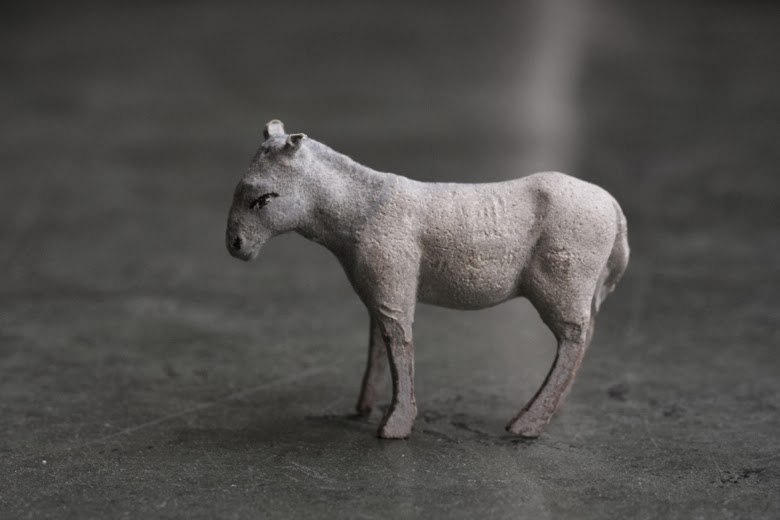
COMPOSITE DONKEY

It is perhaps their raggedy and forlorn appearance that give composite animals their charm. You can read about the history and manufacturing process in a previous post here.  This donkey, found at the Porte de Vanves Flea Market today in among a pile of toy soldiers, was too inexpensive to leave among his more violent brethren.  He reminds me of the tale of Napoleon's journey through the alps. While Jacques-Louis David's flattering painting of the event shows the emperor on a rearing white stallion, the true steed, a mule, was depicted later by Hippolyte Delaroche to mixed reviews.