Showing posts with label Ceramics. Show all posts

Monday, June 27

CROWN DERBY PORCELAIN FLOWERS


I had stopped buying from antique stores and junk markets; that is, until this beauty stopped me in my tracks. Rarely have I seen such a fine example of sculpted porcelain flowers, and I've poked around the ceramic museums of Stoke on Trent, Meissen and Sevres.  And so, with the help of a kind and careful driver I rescued this oversized decantor (?) from it's precarious perch amid lesser objects somewhere on Highway 10.
Although the mark looks a bit like the Meissen crossed swords it is actually a Crown Derby mark from the mid 1800's.  One of England's oldest porcelain manufacturers (around 1750) Crown Derby has gone through many ups and downs.  Most recently, after being amalgamated with Royal Doulton in the 1960's, the firm decided to revert to their own name in 2000, continuing production in England and employing over 300 people.

Major upheaval at the company was happening when this piece was made.  After a quick succession of different owners, the Crown Derby factory was closed in 1844.  An enterprising group of former employees got together, pooled their resources and bought the molds, patterns and some equipment, setting up their own small factory on King street in the town of Derby.  This inspired group carried on the tradition of high quality porcelain dinnerware, figurines and objects until one of the members, Sampson Hancock, took the helm and steered Crown Derby towards Queen Victoria's "Royal" mark of approval, giving the brand todays name of Royal Crown Derby.


Here is a more colourful example found in the V&A collection:


http://collections.vam.ac.uk/item/O334837/bottle-and-stopper-derby-porcelain-factory/

Sunday, March 1

ALISON BRITTON : DOUBLE VESSEL


This Alison Britton vessel from 1987 is currently on display at the Gardiner Museum in the contemporary collection.  I liked how the two patterns can exist independently from different vantage points.  Britton pre-paints the slabs that she uses to create her vessels, thus reversing the process of making.  Her work exists between art and craft and questions the relationship between the two.  She holds an Order of the British Empire for her sevice to the arts.


You can see more examples of an Alison Britton's work here 


Thursday, June 19

BABYGAMA


Atmospheric firing was by far the most exciting part of my time at Guldagergaard in Denmark.  Fueled by firewood (hard and soft), we fired this small anagama (babygama) for 5 days with a team of 8 people.  Stoking the fire around the clock until we reached approximately 1400ºC (2550ºF), the heat of the burning wood solidified the clay but also produced fly ash and volatile salts that settle on the clay surfaces.  The complex interaction between flame, ash and minerals of the clay body creates a natural ash glaze on the pots.  

I had several porcelain works in this firing that went in the kiln totally raw.  I made the forms, applied nothing to the surfaces, and the results were so amazingly dynamic.  Colours of blue, purple, soft pinks and greens, translucent white, and a variation of texture ranging from smooth and glossy to rough, sharp and crusty.  These works will remain a surprise until they are unveiled at a future exhibition.  But, i've included some images here of others works that were in the firebox, meaning tucked as close to the fire as possible, where they became buried in embers and wood ash.  These pieces were by far the most exciting objects in the kiln; crusty blackness, vibrant turquoise, and dramatic crystal growth cover the ceramic surfaces.  Wood firing doesn't have to mean earthy, brown results.


A Japanese term meaning "cave kiln", an anagama is a single chamber kiln in a sloping tunnel structure.  Ancient anagama's were sometimes built by digging tunnels into hills and banks of clay.  These kilns consist of a firing chamber with a fire box at one end and a flue at the other.  The firebox located at the front door of the kiln is not actually a box, but rather a space for the main fire.  Wood is stoked through the front door, but also along the side where fireboxes are created between shelves of ceramics.   The chimney/draft system pulls the flames from the front of the kiln to the back, and the side stokes help to heat the kiln a little more evenly.  Some really exciting "collaborations" happen when the flames knock pieces over and into each other, fusing work together or onto shelves.  Check out this diagram to get a better idea of what's inside.


This firing really changed me because of the deeper connection I developed to the natural elements and the vigorous, focused process of bringing the kiln to temperature with actual fire.  There is something to say for setting an electric kiln with a computer, hitting "start" and walking away, it's amazing, totally care free, but there's something so magical about being with the kiln for every second, listening to it, feeding it, and watching the flames. Atmospheric kilns can also reach higher temperatures than electric kilns meaning the material melts just a little bit extra creating super vitrified, beautifully complex, yet subtle surfaces.  

I loved being outside, in good weather and bad, the camaraderie and conversation, splitting wood, the element of surprise, snack plates and celebratory wine.  Now I will be on the hunt for a wood kiln near Toronto.


Thursday, May 29

CHERYL ANN THOMAS


I saw the strange white abstract ceramic piece pictured above at a design fair back in March and have been thinking about it ever since.  I love how it is ceramic but also looks like fabric and embodies the characteristics of both mediums.  It is both collapsed and very powerful, ripe with tension and anticipation.  I was assuming that it was made by embedding a coarse fabric with slip and sculpting the sodden fabric into shape.  I was wrong.

In searching the internet I came across a similar piece and found the artist responsible, Cheryl Ann Thomas, and became immediately engaged with her practice.  The pieces are actually made by connecting delicate coils together and allowing the forms to collapse in the kiln.  You can watch a video of her explaining her intentions and process here.


Photos taken from Frank Lloyd Gallery 


Thursday, May 8

GULDAGERGAARD STUDIOS


This one is for my fellow ceramics people! There are some nerdy shots of ceramic equipment that may only be of interest to those working in clay, but I'd like to share where I've been spending all my waking hours lately.  The facilities at Guldagergaard are an absolute dream, and can accommodate any ceramic project imaginable.  It is a place to get serious amounts of work done, but also to experiment with new techniques, clays and glazing materials.  The group of artists that I've been sharing the house and studio with have all been so incredibly generous in sharing their knowledge and experiences.

In 2012 the studios went under a major renovation and was reopened in February 2013.  The main floor hosts up to 12 artists who each have their own workspace including a shared plaster room at one end, slip casting room at the other, and electric kiln and glaze laboratory in the middle.  There are 10 sinks (all with clay traps), 4 wedging tables, a drying and damp cabinet, slab roller, extruder, slip pump, industrial clay mixer, jigger jolly machine, plaster wheel, clay lathe, 8 electric kilns of various sizes, and  spray booth.  There is ventilation installed in all shared working areas, a very neatly organized kiln furniture unit, and an efficient system to deal with reclaim and trashed fired ceramics.  

One of my favourite features to this studio is the system for cleaning the floor.  Once a week we spray it down with a hose and squeegy the water to the floor drains.  It's a super easy and effective way to pick up and eliminate dust or clay build up.  It's extremely satisfying.


Below are a couple images of my desk and work area.  I've been throwing elements on the wheel and joining them with hand coiled elements to create larger, open forms with contrasting texture (you'll see one finished guy drying out on my desk ready to get fired).  I'll be firing these works in the atmospheric kilns, letting natural materials like wood ash, soda and fire create the glazes and surface decoration.  I will post, in more detail, examples of works that are fired in atmospheric kilns and I've yet to document the outdoor kiln park which is a very exciting place.


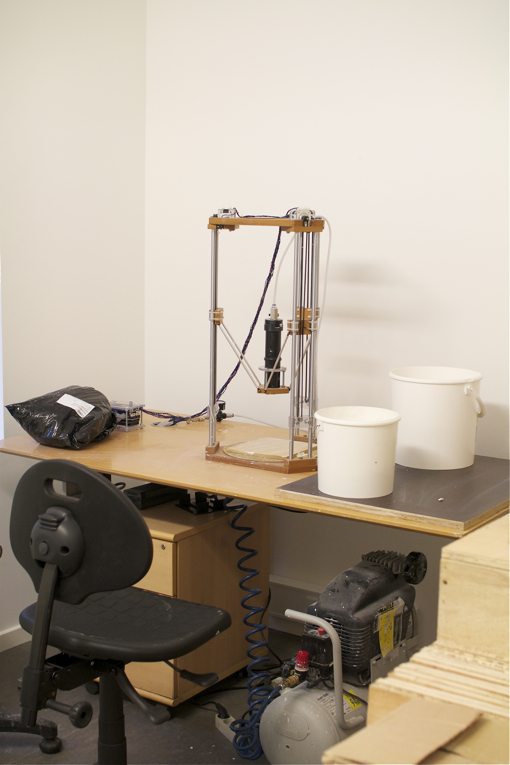
Upstairs is a beautiful, open space and auditorium to facilitate workshops, lectures, and to lay out large scale projects.  Two staircases walled with wood fired bricks are the dominate aesthetic feature on the second floor.  With atmospheric techniques and firing being a large aspect of the centres identity, 6000 bricks were smoke fired in barrels on site (unfortunately I neglected to capture this, but you can see it here).  You'll also find equipment for silkscreening, a 3-D ceramic printer, a decal printer and many works from the Guldagergaard collection.  Sometimes yoga happens here too.


Above is work-in-progress by Danish resident Sten Lykke Madsen.  Below is an outbuilding dedicated to projects other than ceramics.  It's filled with all kinds of tools and equipment for jobs like building shipping crates to fixing a bicycle.  I can't say I'm looking forward to building shipping crates, but I do hope that there will be enough successful work coming out of the kilns to merit the building of a crate.  We'll see.