Thursday, May 29

CHERYL ANN THOMAS


I saw the strange white abstract ceramic piece pictured above at a design fair back in March and have been thinking about it ever since.  I love how it is ceramic but also looks like fabric and embodies the characteristics of both mediums.  It is both collapsed and very powerful, ripe with tension and anticipation.  I was assuming that it was made by embedding a coarse fabric with slip and sculpting the sodden fabric into shape.  I was wrong.

In searching the internet I came across a similar piece and found the artist responsible, Cheryl Ann Thomas, and became immediately engaged with her practice.  The pieces are actually made by connecting delicate coils together and allowing the forms to collapse in the kiln.  You can watch a video of her explaining her intentions and process here.


Photos taken from Frank Lloyd Gallery 


Tuesday, May 27

INSTITUT DU MONDE ARABE


The Institut du Monde Arabe (Arab World Institute) is an organization formed by 18 Arab countries and France to highlight cultural, artistic and scientific achievements of the Arab world through research, education and exchange.  Sitting right on the Seine, this modern structure contains a library, gallery, auditorium and offices.

Jean Nouveu along with Architecture-Studio won the design contract in 1981.  The most striking feature is a huge glass wall fitted with photosensitive metal apertures that open and close to control the amount of light (and heat) entering the building.  My Parisian French teacher passionately despised all modern additions to the city's landscape with this building as an exception.  She approved of the innovative reimagining of traditional patterns found in Islamic architecture through this unique shutter system.


Sunday, May 25

COLLAPSIBLE CUP


My nerves have gone to pieces 
My hair is turning grey
All I do is drink black coffee
Since my man's gone away*

Here's a cup for thrill seekers and highway ramblers.  It's a spill waiting to happen.  Gravity holds the sides vertical when in use but beware of setting your coffee down.  Regardless, it's a charming artifact found in a friend's East London home.


* from Black Coffee by Burke, J.Francis/Webster, Paul Frances 

Thursday, May 22

LOUISIANA


The Louisiana Museum of Modern Art is the most beautiful contemporary art museum I have ever been to.  Located approximately 30km north of Copenhagen, we missed our chance last visit but I feel so grateful to have been able to attend this spring.  The rhododendron and horse chestnut trees were in full bloom, ferns were uncurling and the willows had just opened.  

Aside from the incredible programming and a small, but really interesting permanent collection the building and grounds are so so remarkable.  With glass corridors between galleries showcasing the sculpture garden, the view of Sweden across the sea, a Giacometti room with floor to ceiling glass window facing the pond, and an excellent cafe (with actually decent food) it has become a destination for Danes and many abroad.  We were told last year that if a new Danish couple visits Louisiana on a date, then they are getting serious.  It really is a special place.
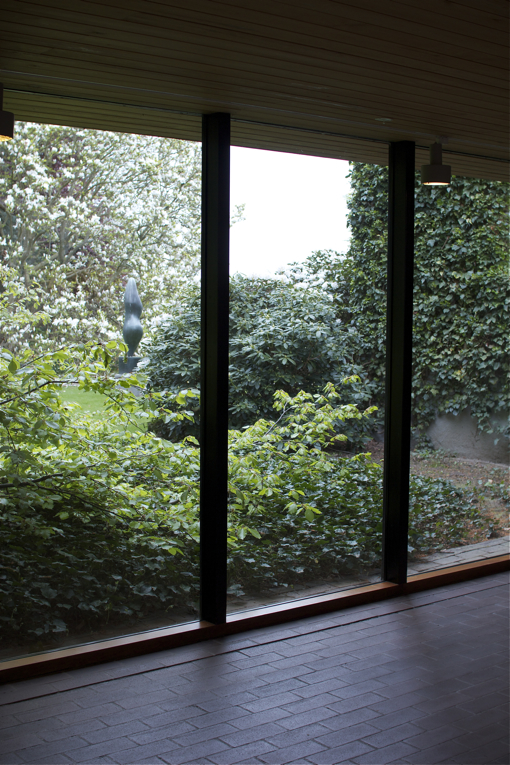


Currently on show now is an extensive retrospective of Hilma af Klint and an exhibition of Joseph Beuys.  We had guest contributor Julia A. Murphy write and document an exhibition of Hilma af Klint in London, England spring 2013.  It is such a great article and if you're interested to read more about her, please revisit this post.  I didn't look at the programming before arriving at Louisiana and was really excited that I had the opportunity to see Klint's works in person.  


The country house was built by Alexander Brun in 1855.  A bee keeper and cultivator of fruit trees, he named the manor Louisiana after his 3 wives who were all named Louise.  Knud W. Jensen took over the property in 1955 and in 1958 opened its doors as a museum under the same name.  Originally intended to be a home only for modern Danish art, it quickly became an international institution.  

From the start, Louisiana's exhibition practices followed the tradition at MoMA, the Museum of Modern Art in New York, which in the first half of the twentieth century had become famous – and notorious – for expanding the range of modern art to include architecture, design, photography, film and other genres. On its own account, Louisiana has also supplemented modern art with cultural and ethnographic exhibitions and placed an importance on the versatility of the program by highlighting the interplay among the various artistic fields.

Since the mid-1950s seven 'discreet' modernist extensions have been added to the original house.  Architects Jørgen Bo and Wilhem Wohlert decided to connect all the buildings in such a way so that visitors could feel like they are on a covered stroll through the park.  In my opinion, a great success.


Tuesday, May 20

FABERGÉ ABROAD : LA PISCINE


Roubaix is a complicated town, quietly nestled in the shadow of its better known neighbour Lille in Northern France. It was once an important epicentre of manufacturing for the textile industry, but now the only indication of this illustrious history are a few dilapidated factory stacks, scattered throughout "the poorest town in France." And yet Roubaix still retains an aura of elegance and progress that spans time. Its velodrome sees the finale of the Paris-Roubaix ("The Hell of the North"), an legendary cycling race dating back to 1896. Jacques Brel held his final public performance here. In recent years is has become an internationally renowned destination for specialty schools in art, fashion and dance. It is as if the ashes of the city are giving birth to itself, a regeneration of hope and possibility. Nowhere is this transformation more elegantly presented than at La Piscine, also known as Musée D'Art et d'Industrie André Diligent.


Elected in 1912 as an aggressive Socialist candidate, Jean-Baptiste Lebas set in motion a transformation of the Roubaix area, building new homes, schools, TB clinics, and other facilities including a commission to build "the most beautiful swimming pool in France". The architect Albert Baert was chosen, as much for his progressive politics as his experience in designing public baths for Lille and Dunkirk. The initial plans were drawn up in 1923, but the pool would not open to the public until 1932 due to the complexity of the arch design and administrative red tape.


A collaboration of Byzantine and Art Deco style, it was modelled after "an abbey, four wings arranged around a garden reminiscent of a cloister." It was a temple of hygiene for the working class, a altruistic sanctuary bearing the Masonic markings of Baert's affiliation. Unfortunately, due to rusting in the steel vault ceiling and ongoing security issues, the pool eventually closed in 1985. In 1998 an international jury competition chose Jean-Paul Philippon as the architect to re-imagine the building as a museum. An empty textile factory next door was annexed into the design to accommodate exhibition space and an outdoor garden.


It is now home to an impressive permanent collection of 19th and 20th century sculpture and painting, and a vast collection of bound volumes containing samples of textile production dating back to 1835. At the time of my visit there was an impressive selection of temporary exhibits: André Fougeron, Jean-René Gauguin, N'Krumah Lawson Daku, Michel Lanos and Fabienne Auzolle. If only I had happened upon the place during one of the rare occasions when performers have been given license to once again dominate the waters of the basin, splashing through an atypically serene pool under the glowing rays of a stained-glass sun.
-HF