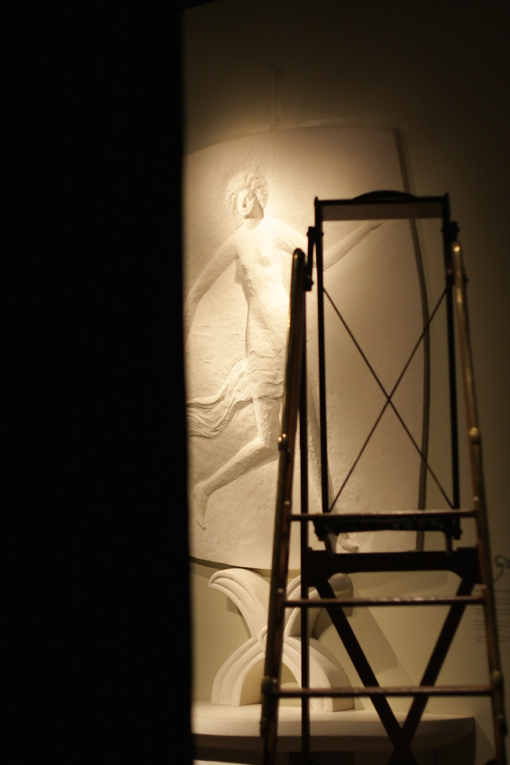
Monday, March 31

LADURÉE


This past weekend I visited Heather in Paris on my way to Skælskor, Denmark.  I had Saturday morning to myself where I walked the galleries at Musée d'Orsay and Musée  de l'Orangerie, and before meeting Heather at the Grand Palais for Art Paris (to be featured on Thursday), I stopped in at Ladurée House to purchase a box of their beautiful macarons.  Available in a wonderful selection of colours, I chose 6 flavours from a legend describing them in French, English and Japanese.  I can see why these would be popular with Japanese tourists, and I too love the novetly of them (you also choose a box in black, pink, mint green or pale blue).

Founded in 1862, a luxury bakery and sweets maker, Ladurée is internationally renowned for their stacked macaron.  In the middle of the 20th century, Pierre Desfontaines first though of taking two macaron shells and joining them together with a ganache filling.  Ladurée sells approximately 15,000 everyday!


Sunday, March 30

ROSENTHAL MOUSE WITH SULPHUR


 This porcelain mouse, by the German company Rosenthal, is quite realistic and beautifully sculpted.  It's chipped ear meant that it was spare change rather than $30-$40.  The dealer who I bought it from commented that his ears could do with a bit of a nibble as well.  Standing in for cheese is a piece of sulphur sent to me by Ms. DiQuinzio.  This element, in crystal lore, is used to promote health and energy as well as remove negative thoughts and energy.  Its sunny yellow colour coincides with these ideas, contrary to earlier associations with Hell under its former name, Brimstone.


Thursday, March 27

PAVILION OF ART AND DESIGN : PARIS


My dear friend Terri Lipman was able to get me into the preview of the Pavilion of Art and Design Fair in Paris.  The purpose-built structure sitting on the edge of the Tuileries Garden reminded me of Gertrude Stein's description of Alice B. Tolkas attending the Salon of the Independents:

I went to the vernissage taking with me a friend, the invitation I had been given admitting two.  We went very early.  I had been told to go early otherwise we would not be able to see anything, and there would be no place to sit, and my friend liked to sit.  We went to the building just put up for this salon.  In France they always put things up just for the day or for a few days and then take them down again.  Gertrude Stein's elder brother always says that the secret of the chronic employment or lack of unemployment in France is due to the number of men actively engaged in putting up and taking down temporary buildings.  Human nature is so permanent in France that they can afford to be as temporary as they like with their buildings.

The invite admitted two as well and we went late but perhaps saw some of the same artists that Tolkas would have.  Although not a massive event, the diversity and quality of the objects on display was splendid.  Pieces ranged from antiquity to present day, some elegant, others tacky or strange and a few sublime. Perhaps it's the consumer in me, but to see works by Edouard Vuillard, Berthe Morisot, and Jean Dubuffet for sale is somehow more thrilling than on view in a public gallery. All this combined with a well heeled crowd made for a fine parade.

The 18th annual Pavilion of Art and Design (PAD) runs from March 27-30.


Tuesday, March 25

TRINITY ALMSHOUSES


There are big changes going on in East London.  A new hospital and library shine bright as old buildings are being converted to upscale housing.  The CrossRail high speed train will be stopping at Whitechapel, making the neighbourhood a commuter's hub.  However, in the shadow of the construction cranes you'll find the Trintiy Almshouses, an old haunt of Captain Cook's crowd.   Built in 1695, the complex looks surprisingly modern with subtle embellishments including fish keystones and miniature ships. Originally intended for  "28 decay'd Masters and Commanders of ship or Widows of such", the seafaring crowd is gone but Whittington's cat remains prowling the lawn.


Thursday, March 20

PHYLLIDA BARLOW : INSTALL AT TATE BRITAIN


While at the Tate Britain a few weeks ago, I witnessed the installation of Phyllida Barlow's new epic piece, Dock, scheduled to open on Monday, March 31.  Barlow is know for using modest, every-day materials such as cardboard, lumber, concrete, fabric and plaster to create monumental works.  Her pieces sometimes evoke temporary scaffolding or construction sites, making the install crew in hard hats and safety vests blend well with the incomplete work.  This pairing made, for me, a dynamic performance.  Dock was created for the Tate Britain Commission which asks artists to both respond to the collection in the gallery and to the grand arcade that will house their piece:

Having seen the space evolve over several decades, I'm very excited by the opportunity to work in the Duveen Galleries.  Considering a body of new work, I was very conscious of two particular contradictory aspects:  the tomb-like interior galleries against the ever-present aspect of the river. 
-Phyllida Barlow