Thursday, November 7

KIASMA MUSEUM OF CONTEMPORARY ART


On now at the Kiasma Museum of Contemprary Art in Helsinki, are two solo exhibitions by Mika Taanila and Erkki Kurenniemi.  Also on show is Kiasma Hits, a tribute to the 15-year-old museum and to Finnish contemporary art.  The show features 50 artists from the permanent collection, commissioned works, and new acquisitions (including some of which are yet to be made). 

Filmmaker and artist Mika Taanila's work dwells in an intermediate zone between experimental video and documentary filmmaking.  Moving between fact and fantasy, the films are incredibly poetic.  One of my favourite pieces, Six Day Run (2013), is a documentary (based loosely on the biblical story of creation), about a Finnish endurance runner and an ultra-marathon in New York.  Another work, The Most Electrified Town in Finland (2012), examines the construction of the Olkiluoto 3 nuclear reactor and how it is changing the physical landscape of Eurajoki, Finland.

Erkki Kurenniemi, a Finnish pioneer of electronic music and early media art, is considered to be a hybrid of Karl-Heiz Stockhausen, Buckminster Fuller and Steve Jobs.  He is one of the forefathers of mathematical musicology and of computer and media culture in Finland.  Kurenniemi's exhibition, Towards 2048, presents work from his personal archive in hopes of launching a virtual persona based on all documentary information that has collected during his life - photographs, videos, diaries, drawings and paintings - to be downloaded for the online persona's mind.  

Following the interior photos of the museum are some of my top choices from Kiasma Hits.  I loved Hannu Karjalainen's video work titled Man in a Blue Shirt (2000) where the portrait subject is concealed by a veil of acrylic paint running down over his face.  Some other artists featured below are Giovanni Anselmo (canvas and granite), Jacob Dahlgren (ribbon) and collaborative duo Tommi Grönlund + Petteri Nisunen (magnets and steel wire).  All the work on show was excellent and the number of pieces on display was perfect.  Awesome.  Unfortunately I didn't record all the artists names featured below.


Tuesday, November 5

PYHÄINPÄIVÄ


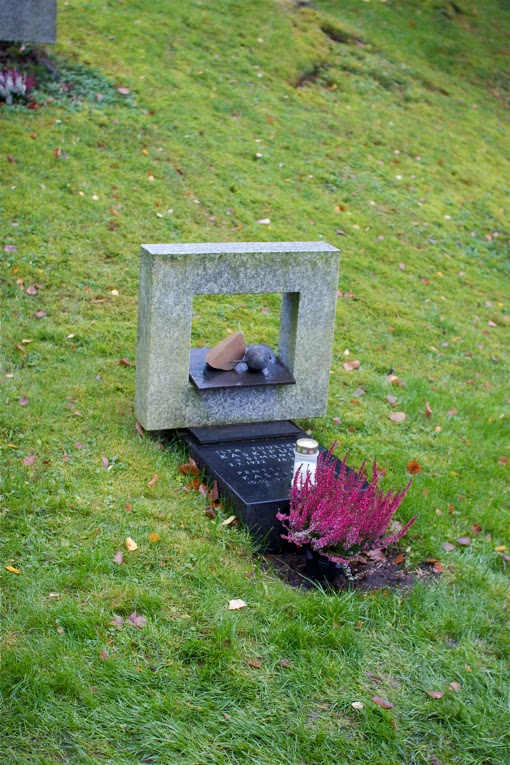
Last Saturday, on a dreary rainy day, we visited the Heitaniemi cemetery to see Finnish families decorating graves and lighting candles for Pyhäinpäivä (All Saints Day).  Pink erika (heather), evergreen, and moss wreaths are popular choices for decoration.  All Saints Day was originally on November 1st, and still is in many countries, but in Finland it's now celebrated from October 31-November 6.  Honouring the Christian saints, the martyrs and the dead, Saturday is the official statutory holiday and when they celebrate their version of Hallowe'en.  We saw lots of festive decorations and young people (not children) dressed in costumes in the bars of Helsinki.  I regret not walking the cemetery at night with all the candles lit.  Apparently it is a beautiful sight.  


Monday, November 4

MORNING IN THE BURNED HOUSE

Morning in the Burned House by Margaret Atwood

In the burned house I am eating breakfast.
You understand: there is no house, there is no breakfast,
yet here I am.

The spoon which was melted scrapes against 
the bowl which was melted also.
No one else is around.

Where have they gone to, brother and sister,
mother and father?  Off along the shore,
perhaps.  Their clothes are still on the hangers,

their dishes piled beside the sink,
which is beside the woodstove
with its grate and sooty kettle,

every detail clear,
tin cup and rippled mirror.
The day is bright and songless,

the lake is blue, the forest watchful.
In the east a bank of cloud
rises up silently like dark bread.

I can see the swirls in the oilcloth, 
I can see the flaws in the glass,
those flares where the sun hits them.

I can't see my own arms and legs 
or know if this is a trap or blessing,
finding myself back here, where everything

in this house has long been over,
kettle and mirror, spoon and bowl,
including my own body,

including the body I had then,
including the body I have now
as I sit at this morning table, alone and happy,

bare child's feet on the scorched floorboards
(I can almost see)
in my burning clothes, the thin green shorts

and grubby yellow T-shirt
holding my cindery, non-existent,
radiant flesh.  Incandescent.

-Margaret Atwood


Sunday, November 3

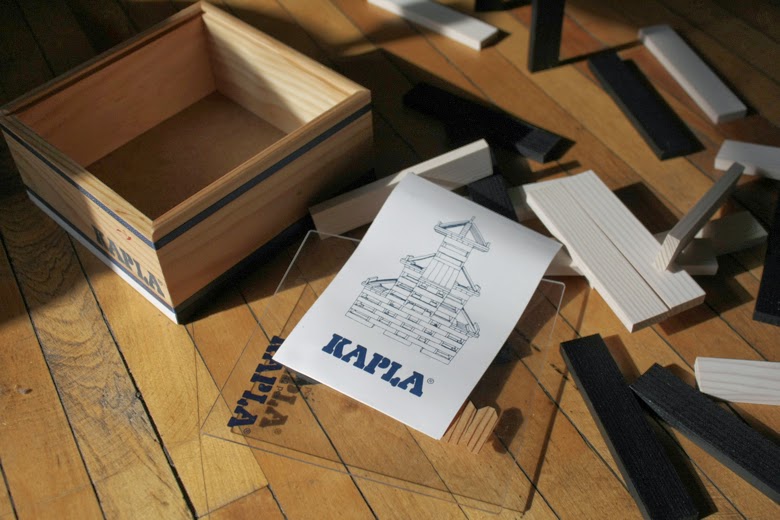
KAPLA

I was introduced to Kapla, "the construction plank for big and small" this sunny Sunday morning and delighted in the simplicity and precision of this popular toy (only regretting the limited size of the set).  Conceived by Tom van der Bruggen in 1988 to build a model of his "dream castle", he developed the little planks into a toy and named it after his native Dutch "KAbouter PLAnkjes" (gnome planks).  Using sustainable pine and non toxic colours, Kapla has been environmentally conscious since inception.  The perfectly uniform nature and proportion (1:3:15) of the shapes allow builders of any age to create massive and complicated structures using no supports or adhesives.  See the video below for an example of impressive Kapla work.