Monday, April 30

TOYE, KENNING AND SPENCER LTD


While visiting his museum in Lincoln's Fields Inn, I learned that Sir John Soane, the English architect, was also the freemason who designed the Freemasons' Hall completed in 1831.  There have been three masonic buildings on this site, the current being erected in 1933.  It's a short walk from Soane's museum and I thought it was worth a try to get inside and check it out.  Turns out there is an incredible library and museum, as well as guided tours of the hall Monday to Friday.  Unfortunately, tours weren't running during my visit and photography wasn't allowed.  However, I was able to shoot some of the interior when I found myself alone.  

Toye, Kenning and Spencer Ltd. is located across the street and is the oldest manufacturer and supplier of fraternal regalia.  Operating since 1685, this family run company services both civil and military markets, priding themselves for superior design and quality craftsmanship.  I enjoyed watching their promotional video.  The shop had an amazing carpeted floor and a display case housing beautiful masonic artifacts.


Sunday, April 29

V&A : CERAMICS


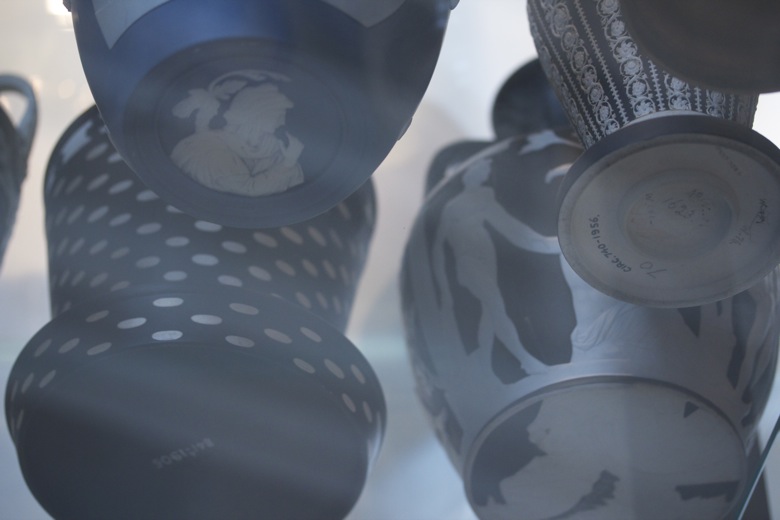
The Victoria and Albert Museum claims to be the world's greatest museum of art and design, and I would have to agree.   A century and a half of collecting with exceptional taste. I immediately go up to the 6th floor ceramics collection.  It is extensive, spanning the entire floor, with skylights above and 10'-12' glass display cases housing the wares.  I love the density of the artifacts installed in these cases and that there are multiple examples, rather than just one, demonstrating wares made in a particular style, era, geographical origin and technique.  The glass cases allow you to look up through the shelving to see the bottoms of pieces, as well as, the backs.  In most museums these views are not often available for observation making this installation particularly remarkable.  

Since the collection was acquired in the UK, I am most partial to studying the wares made in Stoke-on-Trent during the late 18th - 19th century.  The examples here are much more expansive than anywhere else I've visited, with the exception, of course, being the museums at Stoke-on-Trent which are world class.  I have to be ruthless in what I'm going to give my attention to here as there is so much to see.  My interests and tastes change as I continue with my ceramic practice and I hope to return to the V&A's collection many times more to investigate wares from other parts of the world and from other time periods.


I'm very fond of the process gallery. It visually illustrates techniques related to ceramic production, articulates the differences between clay bodies, and presents restorative measures to historical wares and artifacts.  This gallery also houses a studio for the artist-in-residence where you can watch pieces being fabricated amongst the resource displays.  I spend a lot of time in this gallery and frequently reference the collection online for historical forms and decorative techniques.  Below is an image of an overglaze colour wheel.


Below is an image of an installation by contemporary artist Edmund De Waal.   The V&A produced two videos about this project and his relationship to the museum.


Friday, April 27

LAMBS CONDUIT


On the hunt for the perfect suit, we were directed to Lambs Conduit, a charming street lined with shops specializing in British-made brands like Oliver Spencer and Private White.  The visual merchandising for Folk Clothing caught my attention with my eye being particularly drawn to the marble heads standing guard.  Artist Paul Vanstone, a friend to the company, sculpts these enchanting figures.  The gentleman working the shop told me that people often inquire about purchasing them, to which he responds, "only if you can lift it out of here."  It was my great desire to carry one home, but I'm afraid my spaghetti arms would have failed me.   Unfortunately, I was so enamoured of the sculptures, I didn't pay much attention to the clothing.


Thursday, April 26

SONG DONG : WASTE NOT


Waste Not, by performance and installation artist Song Dong, is a beautiful monument to art as a tool for working through the grief of losing a loved one.  Initially installed in at the Tokyo Gallery project space in Beijing (2005) with the help and direction of his mother, Zhao Xiangyuan, this installation comprises the contents of their family home, consisting of over 10,000 household possessions neatly organized and grouped.   

In Chinese culture,  frugality is a virtue: nothing is wasted or thrown away.  For many, living by the maxim "waste not want not" is the only way for a family to survive.  Zhao Xiangyuan took this practice to an extreme after she fell into a deep depression when her husband passed away in 2002.  As an attempt to fill the emptiness,  she began obsessively collecting items, regardless of their possible use, and refused to throw anything away, to the growing alarm of her children.   This project was Song Dong's way of giving her new purpose and a use for all the items she had been hoarding.  In the extended statement that accompanies the piece, Song Dong explains that he became her assistant with this project.  

This collaborative and personal piece is powerful and engaging.  The story accompanying it is moving, but also lends some insight into life in Communist China.  It is visually arresting and illustrates the result of letting go.  The exhibition runs until June 12, 2012 at the Barbican in London.