Thursday, February 7

INTIMATE RELATIONSHIPS


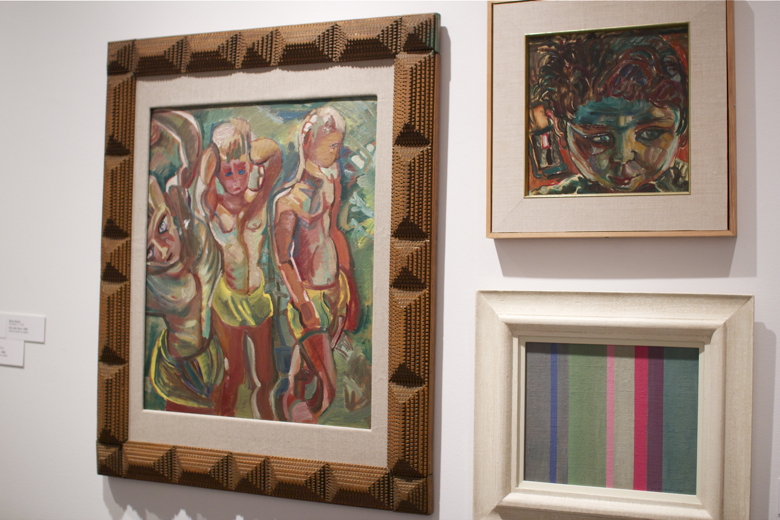
Terri Lipman has been a lifelong collector of art and artifacts.  Her collection is diverse and profound and we've always found great inspiration in visiting her home.  For the first time, part of her collection is on view to the public.  The Robert McLaughlin Gallery is exhibiting Intimate Relationships:  Women Artists in the Collection of Terri Lipman, a survey of Canadian and international artists including Shary Boyle, Jennifer Murphy, Helen Flockhart, Lisa DiQuinzio, Christy Langer,  Laura Carlin, Doris Richardson, Libby Hague, Jori Smith, Pegi Nicol Macleod, Susan Harlander among others.  We're delighted to be included in this stellar group.  It is a pleasure to explore Lipman's collection, as she winds together early 20th century work with contemporary pieces, allowing each work to stand alone yet tell a story with its neighbours.




Wednesday, February 6

NADIA BELERIQUE


Nadia Belerique is pregnant with the inspirational force of the countless images she viewed as photo editor for the Toronto Star. As a recent MFA grad with a photo-heavy component in her artistic practice, she came well equipped to that contract, which involved selecting which archived photos should be converted to digital. Sifting through decades of news shots was stimulating, but it was the cropping, masking, and bylines of the images that germinated more ideas.

It seems that masks and masking are heavy on the artist's mind. We met at the Dufferin Mall to enjoy the food court skylights and ended up shopping for gel masks. Belerique uses objects (perhaps these masks) in her practice to imitate, expound, disrupt or augment her photographs and found images. With a keen intellect and flashes of humour, Belerique is able, with spartan means, to convey the transportive and transformative yet limiting properties of photography. Belerique is showing in March, in the second instalment of The Venn Diagram, a curatorial collaboration between Jon Davies and Kristin Weckworth at Narwhal Projects.

This is what happens when our featured artist helps direct the photo shoot!


Tuesday, February 5

A WINTER TRIP


Lake Worth Florida and Thunder Bay Ontario have at least one thing in common: Finns. My new Finnish cousin by marriage, Ritva, has owned a condo in Lake Worth for five years now, just miles away from the famed Palm Beach coastal stretch and among the second largest Finnish community outside of Scandinavia (Thunder Bay and all her saunas hold the title). And for 6 whole days, Ritva and I were snowbirds in arms. We got up early to exercise, ate chips all day with magazines, and took long foot pumicing walks on the beach.

The steel and concrete walls that line the coast, which were designed to prevent erosion, have become exposed over the years. What's remains today is an intertidal zone of sand, sea life, and some truly fabulous Deco.  

Guest contributor Eve Tobolka


Monday, February 4

LIGHT BULBS


Development of the incandescent light bulb started in the early 1800's but Thomas Edison is often given the credit for the invention as he produced a longer lasting filament, making the bulb a viable domestic light source.  When our government threatened to ban incandescents, we're not ashamed to admit that we started stocking up.  What is the point in creating a comfortable and aesthetic living space if you are going to ruin it with harsh lighting?  That said, this bulb is a bit of a dinosaur, using only 5-10% of the energy it requires to create light (the rest is lost as heat). 

The guilt of excess energy usage in these dark winter days is starting to catch up with us and our passion for the incandescent.  Fluorescent lighting is changing (especially in Europe where incandescent bulbs are partially banned) and perhaps it's time to take another look.  Most manufacturers (including Philips, GE and Sylvania) now sell fluorescents in different colour spectrums, from cool to warm.  If you're looking for a full spectrum bulb however, you're going to have to go to a specialty store.  In Toronto you can get them from Grassroots or The Big Carrot or purchase them online from this site.  Full spectrum bulbs offer the closest to daylight, provide a great working environment and are excellent for combating seasonal affective disorder.

Still, it may be the 90% of energy lost in heat that give incandescents their uncanny warmth and so we resolve to not abandon them but to use them a little more sparingly.


Sunday, February 3

COMPOSITE TIGER


This curious beast is most likely German from the turn of the 19th century.  Animals like this were made from a composite of sawdust and glue, pressed into a mold over a wire armature.  These figures were a cheap alternative to porcelain at the time but due to their fragile nature have become quite rare and collectable today.

Composite was also used to make dolls and toy soldiers.  Developed on a large scale in the 1800's, different manufacturers used secret mixtures ranging from papier mache, sawdust, eggshells, flour, ground bones, breadcrumbs, dirt, plaster and rags with varying results.  Dolls were mass produced  using composite materials until the 1940s when the development of plastics eclipsed this material.


Friday, February 1

KINGFISHER HAIRPIN


This family heirloom in kept in a small Liberty of London box.  Heather suspects that her cousin purchased the hair ornament when she was an employee at Liberty during the 1970s, though its origin is uncertain.  This fine piece of jewellery is decorated with blue iridescent kingfisher feathers (which we first believed to be butterfly wings).  Many kingfisher species are at risk of extinction, mostly due to human activity disrupting their habitat.  I would also assume these feathers have been banned from commercial use, like tortoise shell and ivory.

There are roughly 90 species of kingfisher, most wearing bright plumage in a variety of colours.  These variations of the blues and greens are seen in the pieces featured below.  Painstakingly assembled by cutting and glueing feathers to gilt silver, kingfisher jewellery was produced in China for over 2,000 years, practiced as a high art form and extremely popular for the electric blue colour.  

We are in need of an expert to further identify the piece featured above.  Authentic to China pre-1940s  or a Liberty reproduction?


Below are some other examples of Chinese hair pins and jewellery using Kingfisher feather.  The pieces featured here date to 19th century, Qing dynasty except for the last image, an amazing pair of shoes for the 1950s house of Dior courtesy of FIDM museum.


The evening shoes below are designed by Roger Vivier for Christian Dior, Paris, 1959.  These belong to the FIDM Museum in LA and are iconic for their silhouette, sculptural heel and material decoration.  The only other pair known today is at the Metropolitan Museum of Art.  Read more about the acquisition and view a detail photograph of this artifact here.